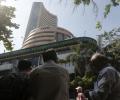
From the Sensex pack, Tata Consultancy Services, Reliance Industries, NTPC, Bharti Airtel, Power Grid, Larsen & Toubro, HDFC Bank, Kotak Mahindra Bank, Tech Mahindra and HDFC were the major laggards. Maruti, Tata Motors, Titan, UltraTech Cement, Bajaj Finserv, Mahindra & Mahindra, State Bank of India and IndusInd Bank were the biggest gainers.

HCL Tech was the top gainer in the Sensex pack, rising over 4 per cent, followed by HDFC Bank, Infosys, NTPC, Nestle India, TCS and HUL. NSE Nifty surged 337.80 points to 14,845.10.

From India, Reliance Industries is the only one in the overall top-200 list and is followed by HDFC Bank at 209th, ONGC at 220th, Indian Oil at 288th and HDFC Ltd at 332nd place.

Riding on a bull run, equity investors became richer by Rs 128.77 lakh crore in the 2023-24 fiscal, driven by robust fundamentals of the Indian economy, increased investment inflows and promising corporate earnings. After a muted performance in 2022-23, equity markets made a remarkable recovery in FY24, giving handsome returns to investors. The 30-share BSE Sensex climbed 14,659.83 points or 24.85 per cent in 2023-24.

Wealth, which can broadly be a measure of assets held as opposed to income earned, is unequally distributed.

Apart from the human body, human food will bear direct repercussions. From staples such as wheat, to coffee, dairy, and even the great Hilsa face the threat of reduced supply due to the extreme heat.

Among the Sensex constituents, Tata Motors was the biggest loser with 6.52 per cent fall, followed by Vedanta 5.09 per cent, Bajaj Auto 4.99 per cent, Maruti Suzuki 4.26 per cent and Tata Steel 2.65 per cent.
Bharti'suarterly revenue run rate continues to be hover around the $1.2 billion mar

HCL Technologies was the biggest gainer in the Sensex pack, rising 5.58 per cent, followed by Tata Consultancy Services and Infosys, State Bank of India, Tech Mahindra, Tata Steel, NTPC and Wipro. In contrast, Nestle, Bharti Airtel, Maruti and ITC were among the laggards.

Investors' wealth fell by Rs 2.89 lakh crore in two days of market fall, with the BSE Sensex tumbling 796 points on Wednesday, amid weak global market trends ahead of the US Federal Reserve's interest rate decision. Fresh foreign fund outflows and caution ahead of a host of interest rate decisions from global central banks also added to the overall bearish trend. Besides, the US Fed meeting, the BoE (Bank of England) and the BoJ (Bank of Japan) are also scheduled to meet this week.

Sun Pharma, Hindustan Unilever, HCL Technologies, Wipro, Tech Mahindra, UltraTech Cement, Tata Steel and Titan were among the other major gainers. Bharti Airtel, Power Grid and NTPC were the laggards.

From the Sensex basket, Tata Consultancy Services, Nestle, Bajaj Finserv, Wipro, Maruti Suzuki India, Reliance Industries, Larsen & Toubro and NTPC were the major laggards. Tata Steel, Bajaj Finance, JSW Steel and Bharti Airtel were among the gainers.

Tata Motors was the biggest loser in the Sensex pack, skidding 1.77 per cent, followed by SBI, Power Grid, Tata Steel, Infosys, UltraTech Cement, Titan, Larsen & Toubro, Reliance Industries and Maruti. On the other hand, IndusInd Bank, Bharti Airtel, Asian Paints, NTPC, HCL Technologies, HDFC and Sun Pharma were the gainers.

Indian telecom companies are scouting for acquisitions worldwide as part of an ambitious attempt to establish a global footprint. Moreover, the growth momentum needs to be maintained amid the falling average revenue per user (ARPUs) and expected saturation in the domestic subscriber base.
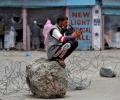
With seven million new subscribers, India accounted for the highest net addition of mobile subscriptions globally in the second quarter of 2023, according to the August edition of Ericsson Mobility. Among national markets, India was followed by China with five million and the US with three million subscribers. The subscriber penetration in India, however, stood at 79 per cent, compared to 120 per cent in China, the report said.

Capital expenditure by Indian companies is likely to see an uptick in the upcoming quarters as capacity utilisation has surpassed the critical threshold of 75 per cent, and numerous companies have deleveraged their balance sheets, according to analysts. The first quarter of the current financial year has shown improved profitability, driven by a decrease in input prices. This, according to analysts at Care Ratings, should stimulate a revival in the private capex cycle.
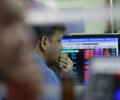
From the Sensex pack, Power Grid, Mahindra & Mahindra, JSW Steel, HCL Technologies, Sun Pharma, Nestle, IndusInd Bank, Reliance Industries, Bharti Airtel and ITC were the major laggards. Tech Mahindra, Wipro, Bajaj Finance, State Bank of India, Bajaj Finserv, Axis Bank, Titan and ICICI Bank were among the major gainers.

The heaviest rocket of the Indian Space Research Organisation -- LVM3-M2/OneWeb India-1 -- blasted off from the Sriharikota spaceport on Sunday to place 36 broadband communication satellites into the Low Earth Orbit (LEO) for a UK-based customer.
Bharti Airtel and five other telecom companies will lay the US-Asia undersea cable, with an estimated cost of $300 million.
Titan surged 2.98 per cent, followed by IndusInd Bank, ITC, JSW Steel, Infosys, Tech Mahindra, Tata Consultancy Services and Maruti. Hindustan Unilever, Asian Paints, Bharti Airtel and HDFC Bank were among the laggards.
From the Sensex pack, Reliance Industries fell the most by 2 per cent. Tata Steel, Bajaj Finserv, ITC, NTPC, Bharti Airtel, Tech Mahindra, Titan, Axis Bank and Bajaj Finance were among the other major laggards.

Benchmark indices--Sensex and Nifty--were 0.7-0.8 per cent higher from the Saturday closing. Among the widely-tracked Nifty 50 stocks, 39 advanced and the rest 11 declined at the opening bell. Among the individual stocks, Cipla, ICICI Bank, Sun Pharma, Power Grid Corp, and Bharti Airtel were the top five gainers, while Asian Paints, Hindustan Unilever, Britania, HDFC Bank, and BPCL the losers, NSE data showed. On Monday, Indian stock exchanges were closed for trading on the occasion of Pran Pratistha of Ram Temple in Ayodhya.

Numbers could be classified further into (140) marketing and (160 or 161) for service calls to easily identify the purpose of the call in the future.

In the Sensex pack, Tata Motors was the biggest loser, shedding 3.29 per cent, followed by ICICI Bank, IndusInd Bank, Infosys, HCL Tech, Axis Bank, TCS, HUL, Asian Paints, Sun Pharma, SBI, Tata Steel and NTPC, which dropped up to 3.23 per cent.

Among the Sensex firms, Kotak Mahindra Bank, Asian Paints, Tata Consultancy Services, HCL Technologies, Infosys, Tata Steel, Wipro, Bajaj Finance, Tata Motors, Titan and Bajaj Finserv were the major laggards. In contrast, IndusInd Bank, ITC, Bharti Airtel, Maruti, UltraTech Cement, Mahindra & Mahindra and State Bank of India were the gainers.
From the Sensex pack, NTPC, Bajaj Finance, IndusInd Bank, UltraTech Cement, Bajaj Finserv, State Bank of India, Tata Motors, ITC, Power Grid and Larsen & Toubro were the biggest gainers. IndusInd Bank climbed 2 per cent after the company on Tuesday reported a 30 per cent jump in consolidated net profit in April-June quarter at Rs 2,124.50 crore, helped by core income growth and lower bad loan provisions.
Indian firms, including Tata Steel, in the past have formed SPVs to acquire foreign companies to protect local operations and also to avoid legal hindrances. The SPV may be registered in a tax-haven country, like Mauritius or Bahamas, the sources said. The move to float an SPV will help Bharti Airtel to continue being listed on Indian stock exchanges, while MTN's promoters will be given a stake in the SPV.

Bharti Airtel chairman Sunil Mittal on Thursday said tariffs need to go up amid "tremendous stress" in the telecom sector, and Airtel will not hesitate to raise prices, but it will not do so unilaterally. The comments by the telecom czar came at a time when Airtel's rival Vodafone Idea has approached the government for a one-year moratorium on payment of spectrum instalment of over Rs 8,200 crore - due in April 2022. Cash-strapped VIL has told the telecom department that while it is working on raising new funding for the last six months, "investors are not willing to invest in the company because they believe that unless there is a significant improvement in consumer tariffs, the health of the industry will not recover and they will incur a loss on their investment".

Leading telecom operator Bharti Airtel on Wednesday said it has earmarked a capital expenditure of $3.1 billion (over Rs 14,000 crore) for India and other global operations in the current fiscal.

Gains in IndusInd Bank, HCL Tech, TCS, Tech Mahindra, NTPC, ITC, JSW Steel and Tata Steel helped the barometer scale a fresh high. Axis Bank fell the most by 1.26 per cent, M&M by 0.99 per cent and Hindustan Unilever by 0.67 per cent. Maruti, Bajaj Finserv, Bharti Airtel and HDFC Bank and Infosys also declined.

Keen to capitalise on the growing geopolitical support from African nations after the recently concluded G20 Summit, India is working with the African Union to hold the fourth India-Africa Forum Summit later this year in Kenya's Nairobi, sources said. Prime Minister Narendra Modi is expected to attend the mega meet along with as many as 50 African leaders, they added. First held in New Delhi in 2008, the India-Africa Forum Summit marked India's initial diplomatic efforts to seek a comprehensive partnership with the African bloc of nations as a whole, at a time when China had begun its own outreach.

Among the Sensex firms, Infosys, Bharti Airtel, NTPC, Tata Motors, IndusInd Bank, Bajaj Finance, ICICI Bank, Tech Mahindra, Titan and Axis Bank were among the major laggards. Tata Steel, State Bank of India, Mahindra & Mahindra, Maruti and Nestle were the gainers.

In the Sensex pack, Yes Bank, IndusInd Bank, Infosys, ICICI Bank, TCS, SBI, Reliance Industries, ONGC, Axis Bank and NTPC rose up to 2.66 per cent.

Benchmark indices ended lower on Wednesday, halting their eight days of rally, ahead of the US Federal Reserve's interest rate decision and mixed global market trends. Also, fall in index majors Reliance Industries, Tata Consultancy Services, Infosys and Larsen & Toubro added to the weak trend in equities. The 30-share BSE Sensex declined 161.41 points or 0.26 per cent to settle at 61,193.30.

The Nifty ended down 80 points (1.5%) at 5,003. During the day, the NSE index dropped below the 5,000 mark to touch a low of 4,992. All indices, barring FMCG, ended in the red. FMCG, has however been one of the worst performering sectors since the Budget day. The BSE realty, metal, bankex and auto indices dropped 2-4% each.

From the Sensex pack, Bajaj Finance, Tata Motors, Asian Paints, Power Grid, NTPC, Infosys, Nestle, Reliance Industries and UltraTech Cement were the biggest laggards. Larsen & Toubro, Tata Steel, HDFC, Bharti Airtel, HDFC Bank and Mahindra & Mahindra were among the major gainers.
M&M was the biggest loser in the Sensex chart, falling 6.39 per cent, followed by Tech Mahindra, Nestle India, Bajaj Finance, Axis Bank, ITC, JSW Steel, HDFC Bank and RIL. On the other hand, Sun Pharma, Tata Motors, Bharti Airtel, L&T and Infosys were among the winners, rising up to 2.10 per cent.

Among top losers that dragged down key indices were Infosys, TCS, Reliance, SBI, Tata Steel and ITC, falling up to 2.15 per cent.
The booming real estate markets in the National Capital Region, Mumbai and Bangalore registered the highest global yields in 2003, according to the latest updates by Chesterton Meghraj, a global real estate consulting group.

The launch of 5G services in India turbocharged mobile download speeds here, pushing the country's ranking 72 notches higher to 47th spot in Speedtest Global Index, ahead of nations like Japan, the UK and Brazil, according to Ookla. India's speed performance has zoomed up 3.59 times since the introduction of 5G, it said dubbing the country's 5G advancement as "remarkable". In this global pecking order, India ranked not only ahead of its neighbours like Bangladesh, Sri Lanka, and Pakistan, but also some G20 countries, such as Mexico (90th), Turkey (68th), the UK (62nd), Japan (58th), Brazil (50th place), and South Africa (48th place).
